
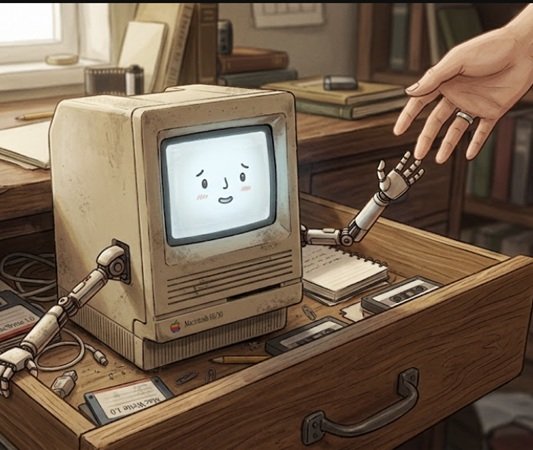
Every home has one. A drawer, a cupboard, sometimes an entire shelf — the place where technology goes when it’s no longer used but somehow can’t be let go. A tangle of chargers for devices that no longer exist. A phone or two from governments ago. And, increasingly often, a laptop: closed one final time, slid under the cables, and never opened again.
It’s such a universal habit that researchers have a name for the phenomenon — hibernating devices — and the numbers behind it are genuinely strange. Britain is estimated to be sitting on tens of millions of unused gadgets, a national museum of personal technology curated entirely by accident.
The question is: why do we do it?
The endowment effect, or why your old laptop feels priceless
Behavioural economists have a tidy explanation for at least part of it. The endowment effect describes our tendency to value things more highly simply because we own them. In the classic experiments, people demanded roughly twice as much to sell a mug they’d just been given as others were willing to pay for the identical mug.
Now apply that to a laptop — an object that held your photos, your university dissertation, your late-night browsing, your half-finished novel. It doesn’t just feel like hardware; it feels like a vessel. Selling it for what the market says it’s worth feels vaguely insulting, so we do the emotionally easier thing: nothing. Into the drawer it goes, where it can remain “worth something” forever, in the way that things we never test the value of always can.
The irony is brutal, because technology is one of the few possessions where sentiment and economics pull in exactly opposite directions. A vintage armchair appreciates while you ignore it. A laptop does the opposite — every month in the drawer quietly shaves pounds off it, and the batteries inside degrade whether they’re used or not. We hoard tech to preserve its value, and hoarding is precisely what destroys it.
The “just in case” fallacy
The other reason the drawer fills up is the phrase *just in case*. The old laptop is kept as a backup — in case the new one breaks, in case a family member needs it, in case it’s useful someday.
There’s a simple test for this logic: has the case ever actually arrived? For most people, the answer is no, and there’s a reason. By the time the hypothetical emergency happens, the drawer laptop is several macOS versions behind, its battery holds forty minutes of charge, and half your apps won’t run on it. A backup that degrades in storage isn’t really a backup — it’s a farewell that hasn’t been said yet.
## What the rest of the world does differently
Britain’s drawer habit looks particularly odd next to how quickly attitudes have shifted elsewhere in our own economy. We happily part-exchange cars. We’ve embraced second-hand fashion so thoroughly that resale apps mint teenage entrepreneurs. Vinted and Depop turned “used” into “pre-loved” and nobody blinked.
Electronics are the last holdout — which is strange, because a used Mac is one of the healthiest second-hand markets on earth. Apple hardware holds value in a way that borders on unnatural for consumer electronics: machines five or six years old still change hands for real money, and the M-series chips of recent years have flattened the performance gap between old and new so dramatically that the second-hand buyer barely feels it. There has arguably never been a better ecosystem in which to sell a MacBook, a phone or a tablet — and never a population more determined to keep them in drawers instead.
The environmental postscript
There’s a bigger cost to the drawer than depreciation. The overwhelming majority of a laptop’s lifetime carbon footprint comes from manufacturing it — the mining, the chip fabrication, the assembly — not from using it. Every existing machine that returns to circulation is potential manufacturing that doesn’t happen; every one that hibernates until it’s truly worthless is a small vote for building a new one instead.
The UK generates some of the highest e-waste per person in the world, and the hibernating-device mountain is the strangest part of that statistic — because unlike genuine waste, none of it is actually broken. It’s a landfill in waiting, made entirely of working things, held in place by nothing but sentiment and a vague sense that we’ll deal with it later.
Opening the drawer
None of this means your old laptop owes you a decision today. But it’s worth knowing what the drawer really is: not a savings account, but a slow leak. The devices in it are at their most valuable — financially, environmentally, and to whoever might use them next — right now, and a little less so every month.
The photos and files were never in the machine anyway; they’re in your backups and your cloud, exactly where you left them. What’s in the drawer is just aluminium, silicon and possibility — and possibility, unlike sentiment, has a shelf life.